Saturday, May 16, 2020

Sword Sunday: Bonus post

So, in celebration of my pending 20th post, I'm taking a moment to talk a little bit about all that we've covered here so far

I kicked things off with an off the wall idea, that actually has a practical military application. 

As much as I wanted this to be apolitical, there are some levels of stupidity that are self evident, and when Andrew Klavan ran his mouth, I was honor bound to put my own take on the argument that  'women can't sword fight'.

I took the opportunity to use some legal foolery as a platform to talk about katanas, judicial combat, and honor duels. 

This was just a good, old fashioned mystery with a cool story behind it. 

This was more a tale about the person than the sword, but also highlighted how even replica swords have standards they can be held to. 

A architectural mishap was the perfect chance for me to talk about the the mythological figure, and the evolution of swords as a concept. 

A rusty word found in England offered a fascinating window into the culture of a Gaelic mercenary band from the later middle ages. 

This was my first serious study of a type of weapon, and I really enjoyed talking about this lesser known civilian's weapon. 

Ironically, the battle in question didn't even involve swords, but this was my chance to go a secular breakdown of one of the oldest surprise military raids even hinted at in military history. 

Again, I really like connecting things to the modern day, and this bit of costume goofyness on the part of a drug dealer was a good opportunity to talk about how men with money also help shape what swords are made. 

I wanted to do this one ever since I started this project, and this was my opportunity. Part sword, part spear, all killing machine, I really enjoyed dong this technical and historical breakdown of my favorite pole-arm. 

In Finland, you get a sword when you get your doctorate... who knew?

This was another weapon's breakdown where I wanted to look for something a little different. This weapon from the Indian subcontinent left its mark in its time, and was respected by those who used it, and faced it. 

I honestly didn't know that much about Ethiopian weapons when I started researching this article, so the shotel was a fascinating discovery for me, as well as fun to write. 

Just in time for Easter, I wanted to talk about the backbone of the Egyptian army.

Really, I avoided this topic for a few weeks because I didn't think I could say much that the papers hadn't said already, but then I realized that putting the age of this weapon in context was eye opening in its own right. 

The western name for one of the largest types of eastern swords, I really enjoyed putting this classic and iconic family of blades in context. 

It looks like the Japanese have a few of their own keepsakes tucked away in old places, and this one offers a bookend to a fascinating piece of weapons history. 

When I saw this bit of news, I knew I had to write about it. Science simply can't get any cooler than when guys in lab coats make you bronze weapons and then tell you "hit things with this!"


His Lordship Ivo Blackhawk
Kingdom of Ansteorra
"Long Live the King!"

Sunday, May 10, 2020

Sword Sunday #19: Hitting things... for science.

As much as we love to talk about old swords, one of the drawbacks to the really old ones is understanding them the same way we understand their younger ancestors. 

Lets face it, when you're talking about something like a 900 year old Kohoki from Japan, its understood that the there are records talking about its use, associated training, manufacture, cost, and effectiveness. But, when you're looking at something like a bronze sword forged during the dawn of civilization, records like that just don't exist anymore, if they ever did to begin with. 

The resulting gap in information has lead to a lot of conjecture, and some researchers have even postulated that bronze swords were more figurative or ceremonial than practical as weapons. 

The idea is not without merit. A number of melee weapons have long and storied histories of being impressive visual displays, and excellent tools for directing battle without ever really being used to directly kill people. The Japanese katana was one such weapon for the last part of its life, being carried by officers in the imperial army until their final defeat in 1945. Another was British sergeant's Spontoon, a short spear carried through the height of the 'redcoat' British colonial era. Both weapons were potentially lethal, but for the times noted here, were never really intended to engage in direct combat, but rather to direct, and inspire others. 

Still, even this idea, no matter how grounded and reserved it may be, is little more than conjecture. Scientists, researchers, and authorities were looking back in time and trying to reason out what they thought should have happened, and doing so through the lens of personal biases and modern sensibilities, an imperfect solution to be sure. 

The single largest hurdle isn't necessarily a lack of information, but an inability to understand it. There are actually a lot of swords surviving today from most of the periods of human history, and over a hundred examples made in bronze. The problem is that as sword-fighting evolved with better metals, so did the metals themselves. Swords got lighter, faster, and sharper, dictating that the methods used to wield them changed as well.

While we have an excellent understanding of medieval and Renaissance sword technique (Thanks in large part to actual written manuals on the subjects), the further back we go, the less information there is. With bronze metal being so much softer, and heavier, we can't even really transfer what we know from the marks and damage taken by iron or steel swords, because there is almost no credible overlap in the materials or techniques. 

Five researchers finally found a way to bridge that gap in our knowledge, and offer scientific evidence to support the argument that not only were bronze swords intended to be used as weapons, but they were so used with sophistication and power. 

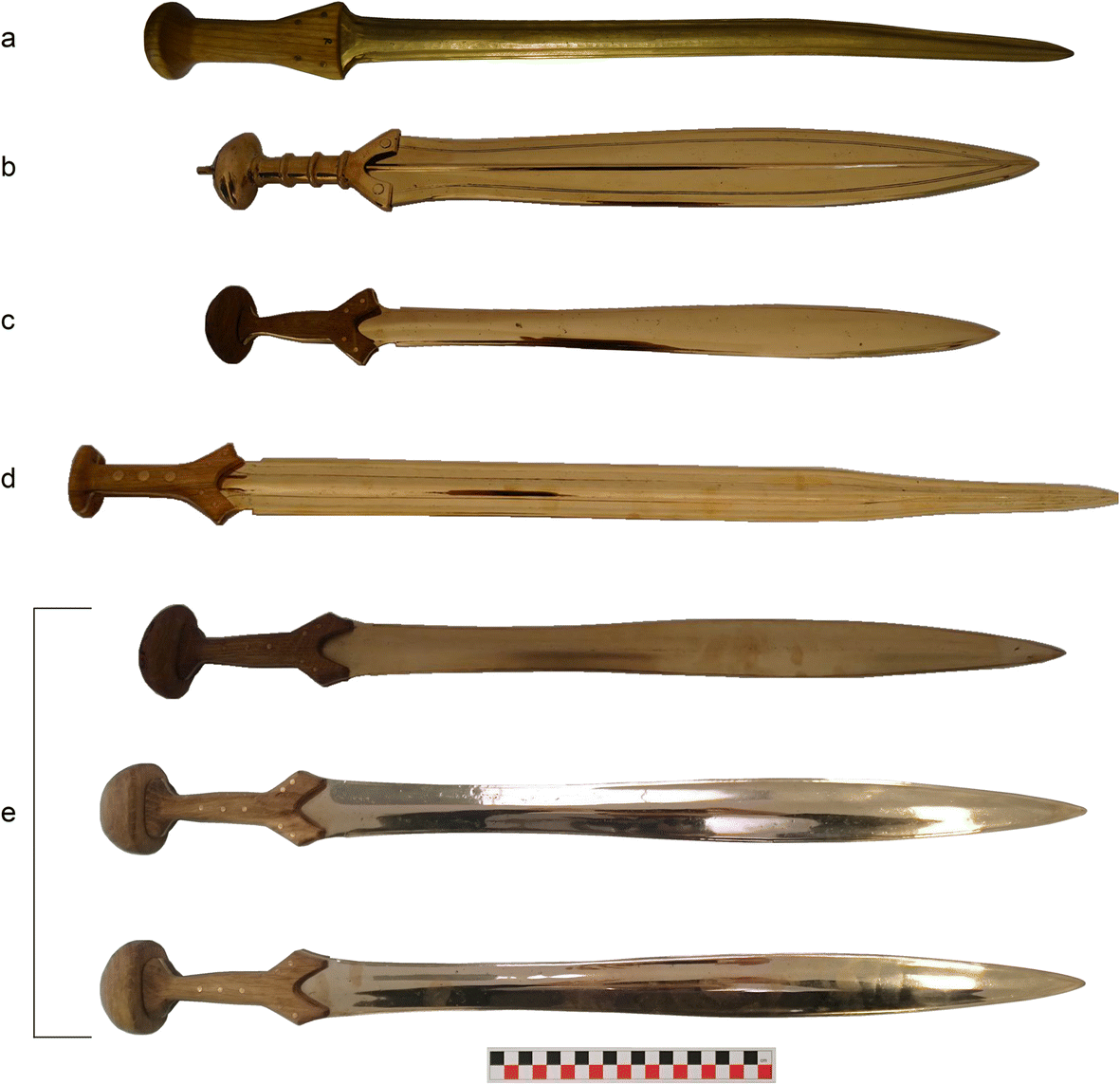
Raphael Hermann, Andrea Dolfini, Rachel J. Crellin, Quanyu Wang & Marion Uckelmann commissioned modern metalworkers to produce several examples of bronze swords using historical materials and technique.

 
Fig. 1
a Group IV rapier (658 mm, 565.0 g). 
b Kemenczei type S Vollgriffschwert (595 mm, 938.2 g). 
c Wilburton type sword (562 mm, 511.5 g). 
d Carp’s Tongue type sword (745 mm, 761.5 g). 
e Ewart Park type sword, the two nearest the bottom were used for the actualistic tests
(top 658 mm, 701.4 g; middle 696 mm, 753.0 g; bottom 695 mm, 752.1 g)


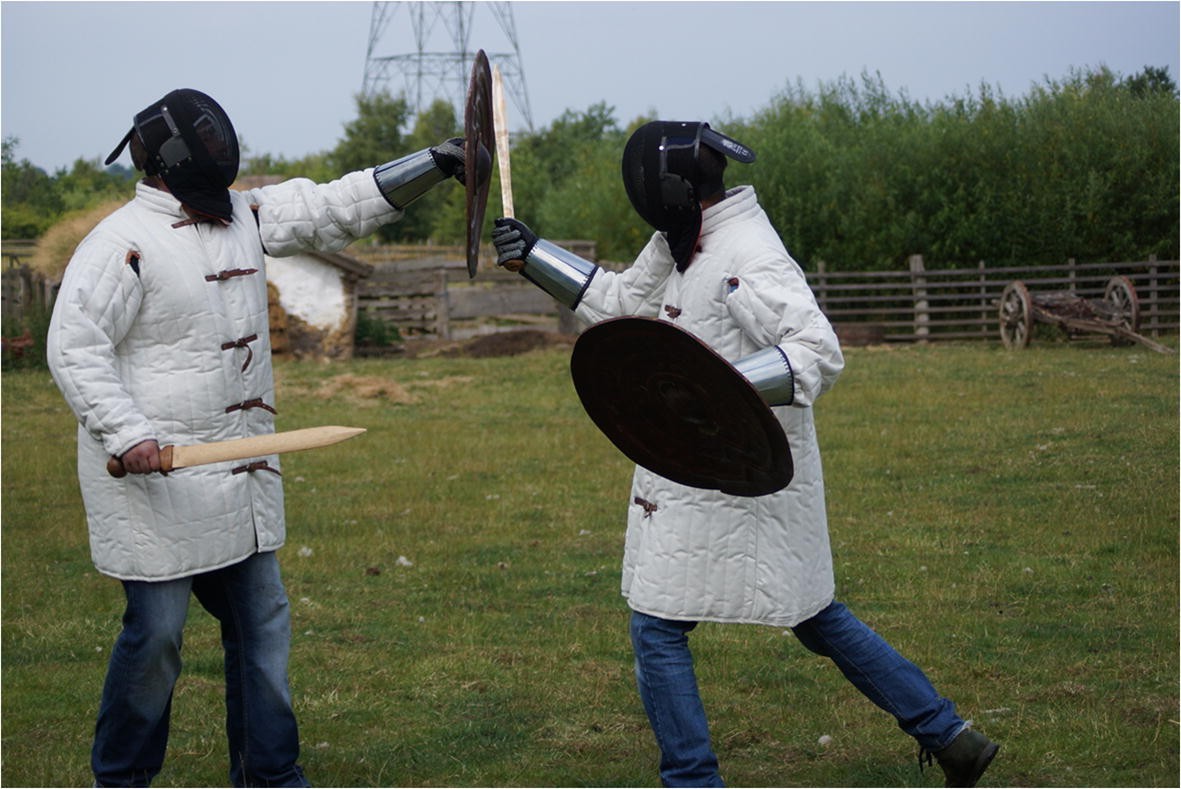
They then employed local sword-fighting clubs to put the blades through their paces with drills, strikes, stabs, and multiple other types of blows. The goal was not to prove they could be used, so much as to offer compelling factual evidence that their historical counterparts were used that way. By taking a detailed, and specific inventories of the damage each example took throughout the testing period, the researchers could then compare that marks, dents, and deformations to historical bronze swords. 
Fig. 3
Controlled Weapons Test


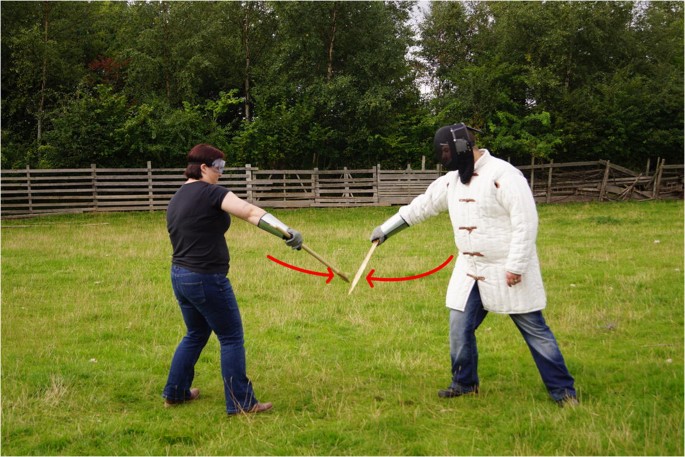
figure4
Actualistic weapon tests: final stance of the fifth play
figure6
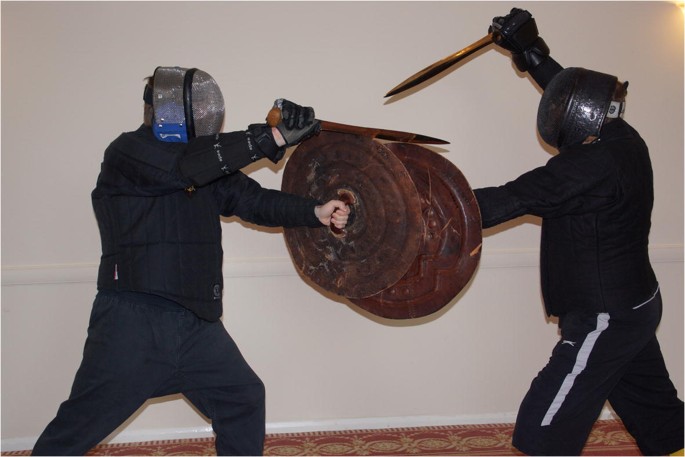
Controlled weapon test 31e.4: long spearhead (on a short shaft) vs dynamic sword edge parry. 

Swords were struck and stabbed against other swords, shield edges, spear hafts, and thrust directly into shields, each impact leaving its mark on the blades. The deformation, dents, bends, nicks, and scrapes were carefully recorded, measured, and cataloged, including where they happened, and how. 

The results, (pardon the pun), are striking. 

The damage taken by each of the blades was found to closely match marks on historical weapons, indicating that those weapons saw actual combat, and not just general wear and tare over 2 or 3 millennium. The information they gathered offers compelling arguments that many of the bronze swords we have examples of from Greece, Egypt, and before had seen regular, and well practiced use in combat. 

Just one example shows the bend in a blade after one specific striking test. The deflection is significant because it is almost identical to a historical weapon at a museum. 

Fig. 17
Replica sword used in controlled weapon test 01k. Note the 10° curvature from the original weapon axis


Fig. 18

Archaeological sword ID 71. Note the 10° curvature similar


The results also note that if we accept that the marks they documented indicate combat damage on museum pieces, many of those pieces look like they were used with similar techniques and against similar types of equipment. 

"The dings were so consistent among swords from roughly the same time and place that it seems impossible the fighters were just swinging wildly" Hermann said in an interview for Science Magazine. “In order to fight the way the marks show,” he added, “there has to be a lot of training involved.”

Their paper goes into a highly in-depth analysis of not only the dents and bends, but the type of microscopic marks on the newly forged blades that, when compared to historical ones indicate some had some cold-forge work done to them, while others did not. 

But the major take away here is that the paper offers highly compelling evidence that not only were bronze swords used in combat, but they were so used with skill, training, and precision.

Christian Horn, a scientists who was not involved in the project, none the less spoke glowingly of its final product. For him, the research is one of the first of its type, offering offer an empirical mode of inquiry into a topic once dominated by speculation.

Barry Molloy, an archaeologist at University College Dublin (also nor part of the research group, but involved in the same field of research) summarized it with "“This is a turning point—it lets us study what kind of actions were avoided and what risks you could take with a bronze sword,” he told Science Magazine. “This shows that yes, they were used, and they were used skillfully.”

Further information on this research can be found in The Smithsonian Magazine, and the Magazine Science. 

Article citation:
Hermann, R., Dolfini, A., Crellin, R.J. et al. 
Bronze Age Swordsmanship: New Insights from Experiments and Wear Analysis. 
J Archaeol Method Theory (2020). https://doi.org/10.1007/s10816-020-09451-0

#Swordsunday is intended as a fun and educational series of posts for the enjoyment of readers. 


His Lordship Ivo Blackhawk
Kingdom of Ansteorra
"Long Live the King!"

Sunday, May 3, 2020

Sword Sunday #18: Another attic, another old sword, and this is is just as awesome.

Well, it looks like we've come full circle here when it comes to old swords in interesting places. First, we talked about a Union Cavalry Saber from the civil war found in a Virginian church.  Then, we talked about a old mercenary's sword found in an attic in the UK. Then, a college student realized that a 'medieval' sword in a monastery was actually older than the great pyramid.

What's next?

Full Sword
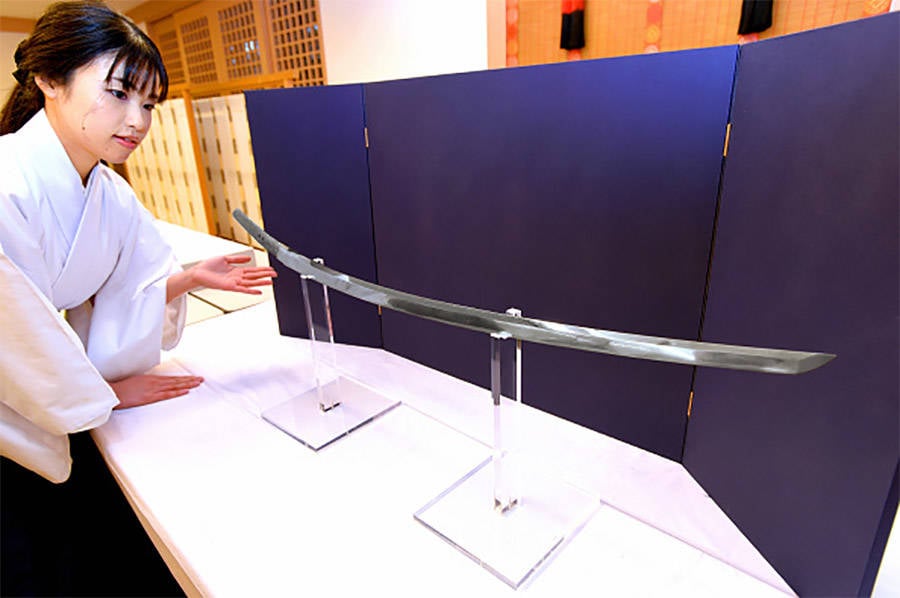
The kohoki blade is believed to be from the 12th century.

Well, not to be outdone, residents at the Kasuga Taisha shrine in Japan found a rusty sword in the building's attic back in 1993. While the discovery is 27 years old, it was only recently that the weapon was properly cleaned and restored in a traditional ceremony that only takes place every two decades. The style of the weapon, as well as characteristics of its construction lead historians in Japan to believe the weapon was made during the Heian period (794-1185), and given to the shrine as a gift several centuries later, possibly during the Nanboku-cho Period (1336-1392), or perhaps the later Muromachi Period (1338-1573). 

In either event, this discovery is moments because the sword while the sword has the characteristics of a Katana (The 32-inch sword is actually known as a kohoki, one of the early types int he broad katana family), its age would make it the oldest surviving such blade of that type. The weapons curve is one of the most telling traits, since Japanese swords are not forged with eh curve, but rather it is created as part of the differential hardening process that helps to both give the blade its razors' edge, and give the sword's spine its strength.

To put this in perspective, the Samurai, perhaps the most iconic class of warriors to ever wield a sword of any type in Japan, first rose into national prominence during the Kamakura period (1185–1333). They would remain a cornerstone of Japanese political, social, and military culture until their were disbanded in 1870. As a class , the Samurai existed contemporary to (but obviously had no contact with) king John of England (reign 1199 - 1216), made famous, or infamous by the Robin Hood fables, until the incorporation of Standard Oil by John D Rockefeller in 1870, 5 years after the end of the American Civil War. 

A total span of  670 years.

This sword is possibly a hundred years older than the Samurai. 

While there are a large number of historical artifacts and relics from most of Japanese history, this sword, if the age is accurate, would be the oldest existing example of the single blade, deferentially-hardened style that marked the transition from the Jian, straight bladed weapon. As an artifact, it is hoped that it will provide additional information into that period of Japanese metalwork and blade smoothing, and as a cultural point, for a nation that is as strongly linked with a sword type as it is at a cultural level, the local community will undoubtedly welcome the relic into their ever growing historical narrative.

His Lordship Ivo Blackhawk
Kingdom of Ansteorra
"Long Live the King!"