Saturday, August 29, 2020

Sword Sunday #36 - A busy week for swords!

My my my, where to being?

Oh August 24th, the Smithsonian Magazine ran an article about a kid who, right now, is the embodiment of beginner's luck. In July,  Fionntan Hughes received a metal detector for his birthday. On his and his father's first trek out with the new device, along the river Blackwater in Northern Ireland, the pair discovered a sword buried in the riverbank, about a foot deep. 

Sword
10-year-old Fionntan Hughes found the sword on his first day 
using a new metal detector. (Courtesy of Brian Quinn/Clonoe Gallery)


The rusted and pitted weapons is some type of basket-hilted weapons with an ornate pommel and broken blade. The rust-covered item has yet to be turned over to researchers for a more detailed study of it, but a cursory look at the photos has lead to some speculation:
The sword’s ornate handle is its most identifiable feature, but antiques experts Mark and David Hawkins tell BBC News that the sword is difficult to identify from photographs because the rust may be exaggerating its size. But it looks like an English basket-hilted broadsword that was introduced between 1610 to 1640.


On August 25th, he Vintage news ran an article about the discovery of a bronze age sword located in Scotland. 44 year old Mariusz Stepien was going to a field with his metal detector, looking for any artifacts that the soil might have to offer. What he actually found was more than just a sword. The weapon was part of a larger collection that looks to include  the sword (still in its scabbard), chariot wheel axle caps, and an entire horse harness, along with a decorative rattle pendant that would have been placed on the harness, the only one like it ever found in Scotland!

Stephien contacted the Crown Office Treasure Trove Unit, a movement office that specialized in this type of discovery. Emily Freeman, the head archaeologist with the unit who went to investigate the find, recently told the BBC, “it’s a nationally significant find.” The unit took 22 days to excavate the full discovery. 

The heavily rusted and crusted over blade is going to be studied with an x-ray in order to learn more about the metalwork, detail, and any etching that might have been put into the blade. 

note: the article had a full 3D scan of the dig site, and annotations of the items in the image. 


On August 28th, Gizmogo ran an article talking about a viking funeral site in Norway with some unusual characteristics, not the least of which was the positioning of the weapons (specifically the sword) with the body, leading the researchers to believe the one-time warrior was left-handed. 

Speaking about the sword in the article:
“I’m a little surprised at how heavy it was,” Astrid Kviseth, an archaeologist at Norwegian University of Science and Technology (NTNU), told Science Norway. “I don’t exactly know how heavy a sword is, but it had some heft to it. You would have had to be pretty strong to be able to swing this sword!”
About the position of the sword, it went on to add:
Normally, swords are placed on the right side of a Viking grave, which may sound strange given that right-handed people keep their sheaths on the left side of their bodies for easy access. A going theory is that the Viking afterlife, or underworld, is the “mirror image of the upper world,” Sauvage explained. The unusual placement of the sword suggests the warrior was left-handed, as this configuration best prepared him for the afterlife, according to the archaeologists.
A final note of interest, albeit not sword related, was the additional discovery of a grave in the same area that, based on the artifacts located there, was a prestigious resting place for a woman. Unique in this find was the type of remains. The weight of cremated bone in this site was consistent with a fully cremated human body, where most funeral sites of this type only have a tiny fraction of that much bone...consistent with a human skull. As to why this was, researchers aren't sure, but as a find, it is still facilitating. 


His Lordship Ivo Blackhawk
Kingdom of Ansteorra
"Long Live the King!"

Sunday, August 23, 2020

Sword Sunday #35 - A Frankish import for the Scandinavian warrior

In the late 7th century, one of the truisms of metalwork in Europe was that the farther north you traveled, the less quality there was in the available steel. Native blades from locations like modern Norway, Denmark, and Holland were of notably inferior quality to weapons made in the Frankish Empire during the Carolingian era. 

Compounding this was the fact that following the collapse of the roman empire centuries before, much of the industry and knowledge of metalwork was effectively lost to much of Europe. Where the Romans were able to muscle out high quality steel blades in the form of their hundreds of thousands of gladiolus, the people of the then modern Europe struggled to produce even a fraction of as many blades, and few were of any quality to compare. 

The industry and money brought together under Carolingian's reign allowed for swords to again be produced, but compared to their roman predecessors, they were outlandishly expensive things, fit only for the riches and most elite of combatants. In modern terms, the cost as been projected as $1,400 USD equivalent. several times the cost of a capable modern repeating rifle. 

Viking swords closeup.jpg

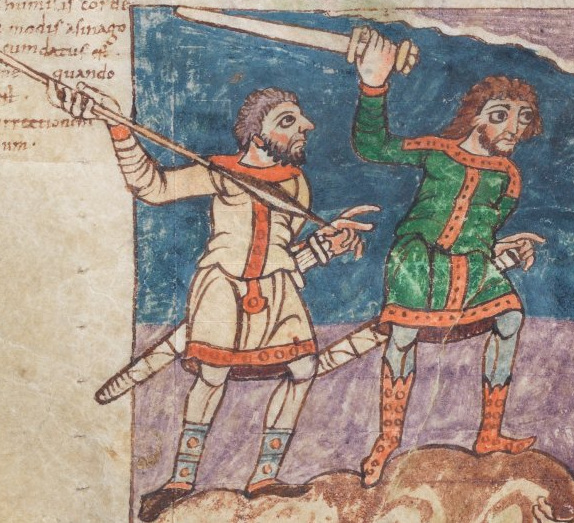
The sword produced was a unique design, evolved from Merovingian sword, the Frankish blade was characterized by a lobed pommel that both offered a counter weight  to offset the blade, and a stop to keep the hand on the handle. It was edged on both sides of the blade,, tapered to a good point, and used one handed. The design would be the forbear to the arming sword, centuries later. 


Due to its high cost, only the wealthy, and at that time, that mean the powerful as well could carry it. Nobles, royals, and their elite guard would likely be the only ones to carry it in the early 8th century, though it likely was slightly more prevalent by the end of the same. 


The weapons were durable, strong, and deadly, all things that the native blades of the north could not boast in the least. For the soldiers, nobles, and more famously raiders  (called 'viking') of the Scandinavia kingdoms and tribes, the answer was simple. 

They reached out and traded, purchased, and if needed, stole the requirement armaments from their southern neighbors. 

While there is no doubt that they took weapons from the dead, there is also ample record that larger purchases were made, or even attempted though more formal business routes. The practice was common enough that  864, Charles the Bald made the penalty for selling weapons to the vikings death. 

And the resistance to the transfer was not merely political. Viking raider and their now famous long-ships have been charted as far south as the mouth of the Mediterranean sea,  and it was only a generation into the 9th century that the great migration took place, where whole families would not only land, but settle in both modern England, and northern France, becoming Normandy (which literally translates to "land of the north men") in time. The blades used in their conquests ever overwhelming 'imported' (or stolen) from the south, including the franks, and their neighbors. 

And this is why in the modern age, even among scholarly circles, a whole class of weapon that was exclusively made in France, and used extensively by Frankish troops, would be called 'the viking sword'. 

His Lordship Ivo Blackhawk
Kingdom of Ansteorra
"Long Live the King!"

Sunday, August 16, 2020

Sword Sunday #34 - Bollywood, actors, and swords (in that order, no less)

Movies and sword fights have been joined at the hip as a cultural icon since movies like Captain Blood put men like Errol Flynn on the silver screen. Its no surprise that when the Indian movie industry joined the international market, they had their own share of sword fights in films and even today in an age of CGI and space ships, the fantastic, and even fantastical epic sword fight is a heavy cultural fixture for movies in general, let alone movies from the Indian subcontinent. 

What sets today's post apart is that its not about a movie sword fighter, but rather about an actor who actually can swing a sword, even if she hasn't done it on screen...yet.  

In a resent interview, dramatic performer Yaaneea Bharadwaj talked about her personal studying of Nunchak and sword fighting technique, a study separate from her acting career. 

Yaaneea, who is from Himachal Pradesh, India, rose to international recognition with her supporting role in the "Made in Heaven", a hindi-language dramatic series chronicling the traditions and internal conflicts in the modern wedding culture in India. 

Amazon.com: Watch Made In Heaven - Season 1 | Prime Video

Yaaneea reportedly nailed the character Sukhmani in the episode ‘A Marriage of Convenience’. She played a Punjabi girl who desires to go and live in America but has to settle for a green card husband who suffers from impotency. - Bollywood Flim Flame Canada

Full disclosure: The series is available on Amazon Prime, and while I have not watched it, it did get added to my watch list. 

In the interview, she spoke about what drew her to the two weapons styles. 

"As an actress aspiring for world cinema and international entertainment projects, I wanted to dare to do something different - nunchucks and swords excites me .. I feel I am connected to them and I feel strong. I love practicing with sword and Nunchak to remain fighting fit. " She add, "As an actress I can position myself differently. Nowadays, international warrior series such as 'Cursed' and 'The Witcher' are on top of the charts and I want to become the first Indian actress with sword fighting capabilities to get a role in such prestigious global projects." - Yaaneea Bharadwaj

While the series does not feature any sword combat at all, Yaaneea is not so pacifistic in her private time. She encouraged young women and girls from both urban and rural homes to study weapons fighting in order to learn both self confidence and self defense. 

"And all Indian girls in urban and rural India should learn and practice them. In fact, some villagers in [Himachal Pradesh] gave me a rare historic artifact sword to practice."


The Nunchak, (also known as the Japanese nunchaku) were made world famous by Bruce Lee in the 60s. These weapons, derived from a farmer's wheat thrashing tool, are nominally good striking weapons, but excel at wrapping around an opponents weapon, or hand, or wrist and controlling their movements with crippling levels of force, and even pain if needed. Modern day practitioners of the weapon's stile are well regarded for the flashy presentation and blinding speed the weapons show during demonstration.


While the interview didn't talk about the specific style of sword, or sword fighting technique Yaaneea practices, the photos included in the interview show her holding a simple, but beautiful  curved bladed saber style weapon that, even without an edge, could probably deliver a devastating blow to a person's arms or lets. 

Photo by Vikram Bawa

Even if the practicality of using melee weapons in self defense is questionable, there can be no doubt that the attributes of physical fitness, emotional confidence, and improved hand-eye coordination and reaction times would benefit anyone, both personally and professionally. 

Photo by Vikram Bawa


Yaaneea Bharadwaj's interest in weapons study and acting are both personal marks of her dedication and ambition, and reflective of the new level of opportunities available to women in India as the nation grapples with clashing old and new attitudes towards gender roles and women's rights, and 

Photo by Vikram Bawa


His Lordship Ivo Blackhawk
Kingdom of Ansteorra
"Long Live the King!"